🧑 About Me
I am a first-year Ph.D. student in the Department of Electronic and Computer Engineering at the Hong Kong University of Science and Technology (HKUST), jointly supervised by Prof. Wenhan Luo and Prof. Ping Tan.
I received my M.S. in Electronic Information (Artificial Intelligence) from Tsinghua Shenzhen International Graduate School (SIGS) in July 2026, advised by Prof. Haoqian Wang. Previously, I earned my bachelor’s degree in Aircraft Control and Information Engineering from Beihang University in 2023.
My research interests include efficient video generation, controllable video generation, and image and video restoration.

💻 Experience

Ph.D. Student
Hong Kong University of Science and Technology · ECE
Jointly supervised by Prof. Wenhan Luo and Prof. Ping Tan, focusing on efficient and controllable video generation.

Research Intern
Tongyi Lab · ATH · Alibaba Group
Research on video generation, with an emphasis on model fine-tuning and efficient generation.

Full-time Research Intern
Amap · Machine Learning R&D · Alibaba Group
Supervised by Xiangxiang Chu and Yong Wang.

M.S. in Electronic Information
Tsinghua University · Artificial Intelligence
Graduated from Tsinghua SIGS under the supervision of Prof. Haoqian Wang.

Bachelor's Degree
Beihang University · Aircraft Control and Information Engineering
🏆 Honors and Awards
📚 Publications
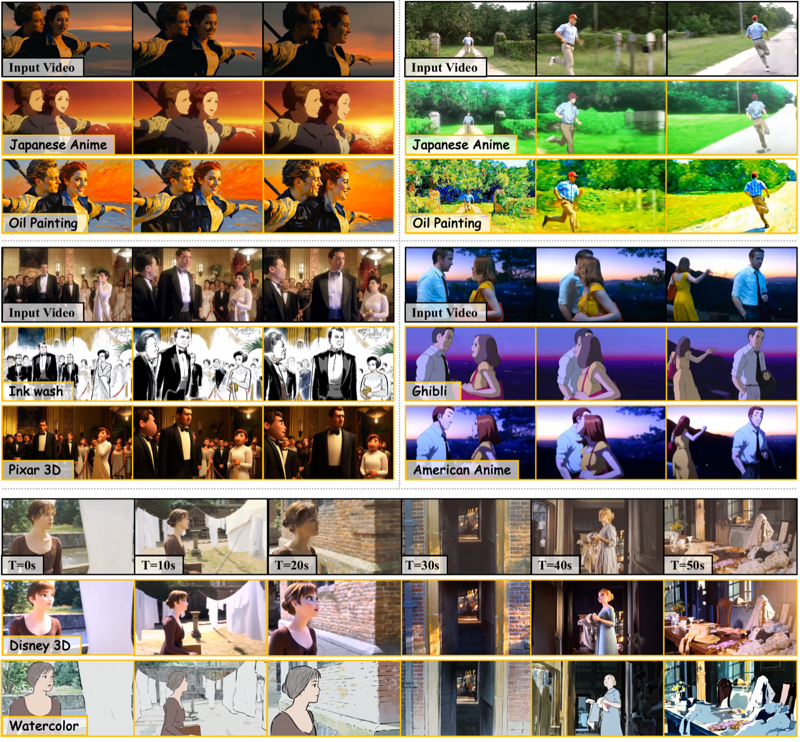
EchoStyle: Unlocking High-Fidelity Video Stylization with Reverse Data Synthesis
Huaqiu Li*, Jiahao Wang*, Sijia Cai†, Hualian Sheng, Bing Deng, Jieping Ye, Wenhan Luo†
Project Paper Code Model
- We introduce EchoStyle, a scalable text-driven framework for high-fidelity video stylization of arbitrary-length videos. It combines a video-to-video architecture, the reverse-synthesized V-Style20k dataset, and init-follow-mode sliding-window inference to preserve style, motion, and temporal consistency.
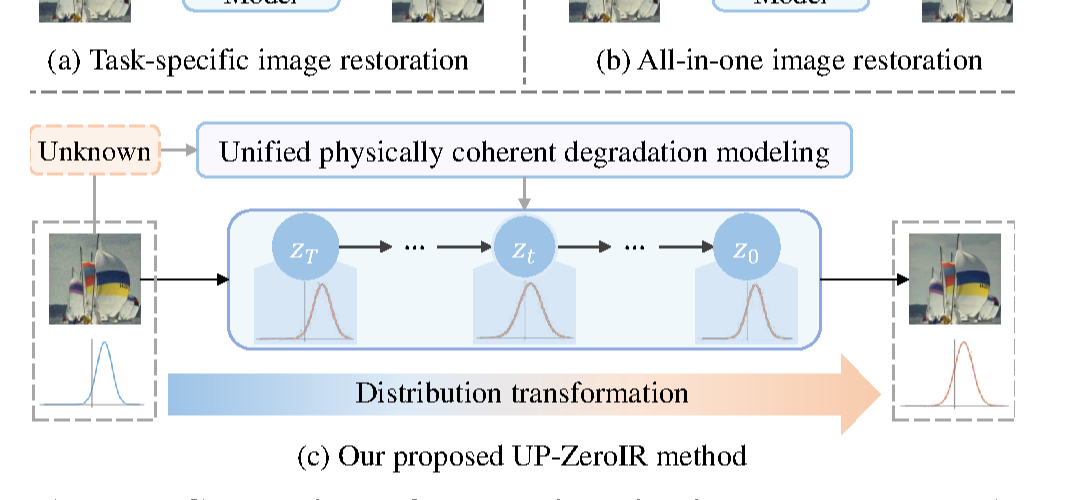
Self-supervised Dynamic Heterogeneous Degradation Modeling for Unified Zero-Shot Image Restoration
Xiaowan Hu*, Jing Yang*, Henan Liu, Huaqiu Li, Mai Xu†
CVF arXiv
- We propose UP-ZeroIR, a self-supervised unified physical zero-shot restoration framework that models heterogeneous degradations as a homogeneous latent-space distribution. A dynamic quality-refinement strategy adaptively adjusts the diffusion trajectory for robust restoration across both single and mixed degradations.
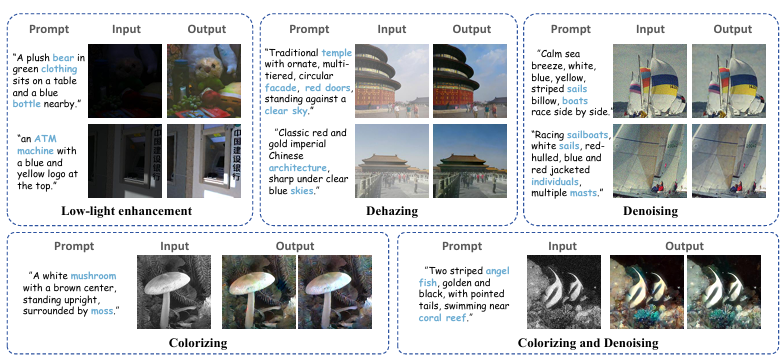
LD-RPS: Zero-Shot Unified Image Restoration via Latent Diffusion Recurrent Posterior Sampling
Huaqiu Li, Yong Wang†, Tongwen Huang, Hailang Huang, Haoqian Wang†, Xiangxiang Chu
Project ICCV Paper Code
- We propose a dataset-free, task-blind unified image restoration approach based on recurrent posterior sampling with a pretrained latent diffusion model and semantic priors from a multimodal understanding model.
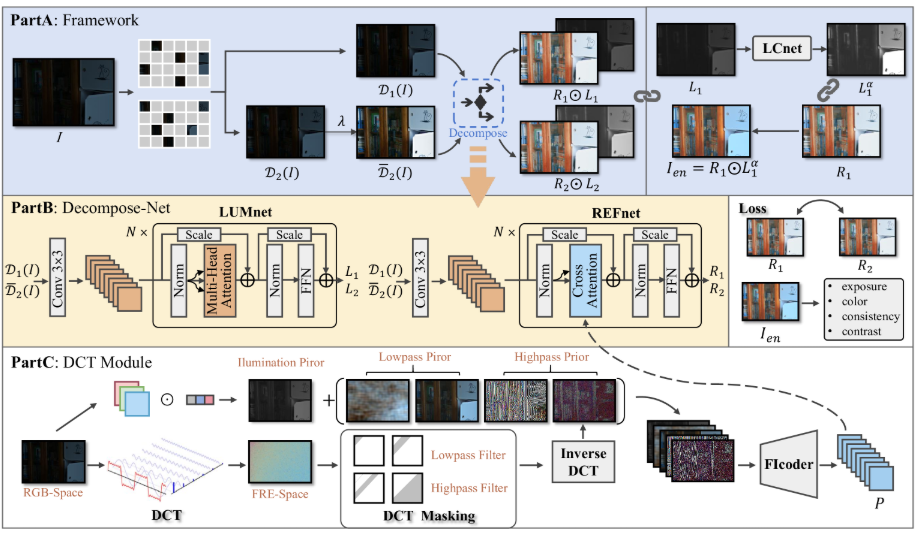
Interpretable Unsupervised Joint Denoising and Enhancement for Real-World Low-Light Scenarios
Huaqiu Li, Xiaowan Hu, Haoqian Wang†
Project ICLR OpenReview Paper Code
- We propose an interpretable, zero-reference joint denoising and low-light enhancement framework tailored for real-world scenarios. Our method derives a training strategy based on paired sub-images with varying illumination and noise levels, grounded in physical imaging principles and Retinex theory.
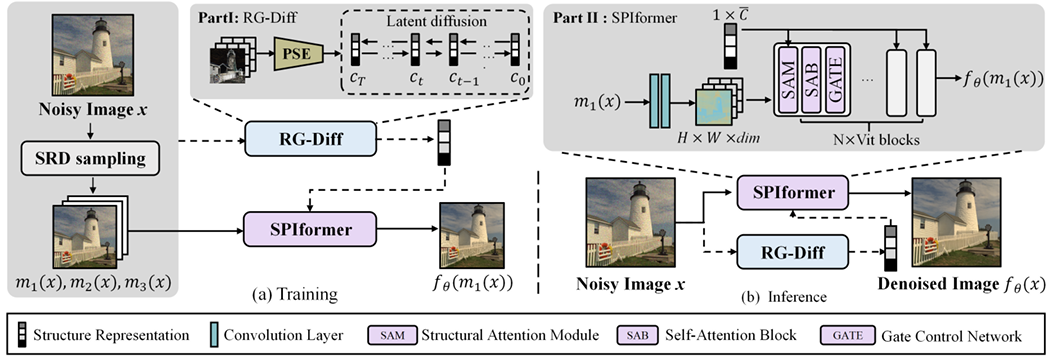
Prompt-SID: Learning Structural Representation Prompt via Latent Diffusion for Single-Image Denoising
Huaqiu Li*, Wang Zhang*, Xiaowan Hu, Tao Jiang, Zikang Chen, Haoqian Wang†
Project AAAI Paper Code
- Prompt-SID is a self-supervised single-image denoising framework that preserves structural details by learning a latent structural representation from the noisy image; “prompt” here does not mean a natural-language prompt.
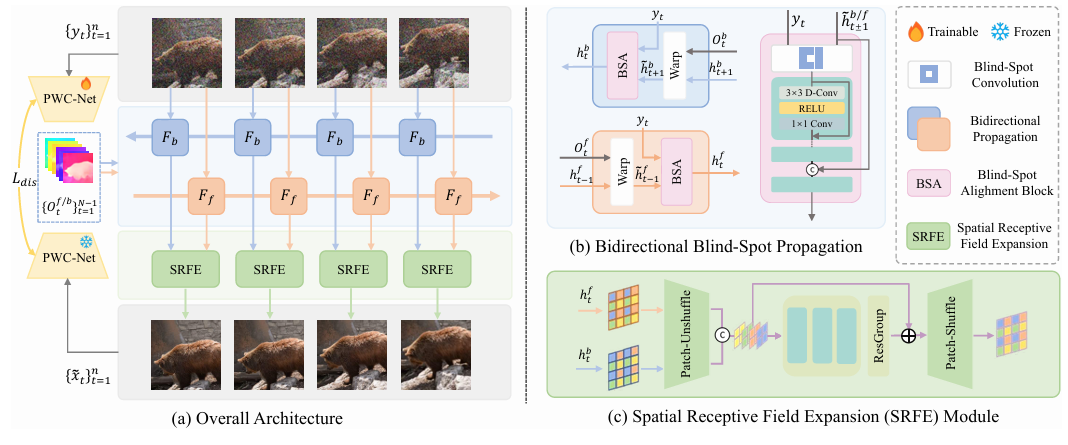
Spatiotemporal Blind-Spot Network with Calibrated Flow Alignment for Self-Supervised Video Denoising
Chen, Zikang; Jiang, Tao; Hu, Xiaowan; Zhang, Wang; Li, Huaqiu; Wang, Haoqian†
Paper Code
- We explore the practicality of optical flow in the self-supervised setting and introduce a SpatioTemporal Blind-spot Network (STBN) for global frame feature utilization.
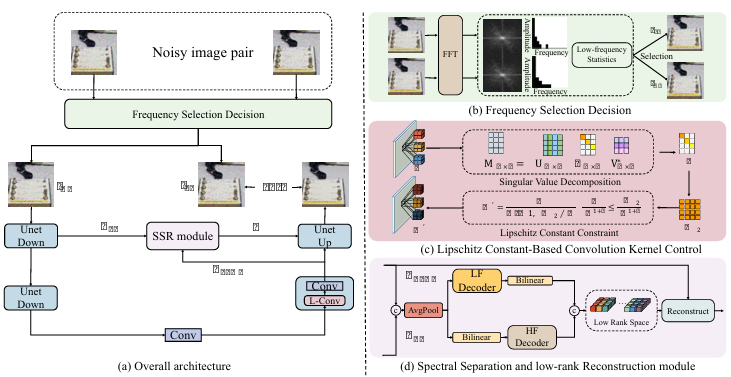
Measuring and Controlling the Spectral Bias in Self-Supervised Denoising
Wang Zhang*, Huaqiu Li*, Tao Jiang, Zikang Chen, Haoqian Wang†
Paper Code
- We introduce a Spectral Controlling network (SCNet) to optimize self-supervised denoising of paired noisy images. First, we propose a selection strategy to choose frequency band components for noisy images, accelerating the convergence speed of training.